US
US 

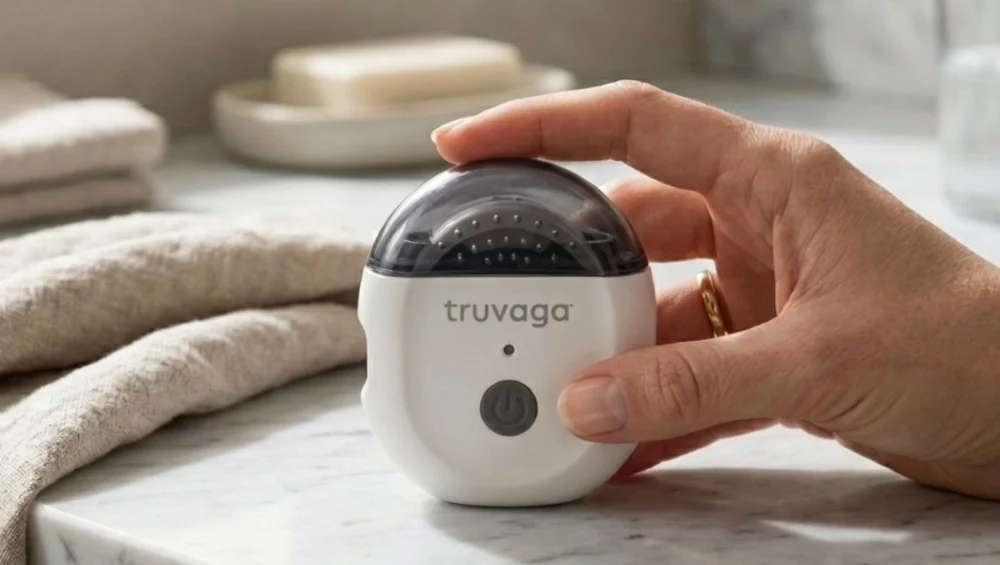
I’ll be honest, when I first used Truvaga and felt a buzzing sensation on my neck. I immediately wondered if I was doing it wrong.
You’ve probably seen the promises: reduced stress, better sleep, improved focus. All from a handheld device you use for two minutes, twice a day. What the marketing doesn’t always prepare you for is the learning curve: the trial and error of finding the right placement, the discipline required for daily consistency, and the patience it takes to see real results.
After spending several weeks with Truvaga and talking with other users, I’ve collected everything I genuinely wish I’d known going in. Whether you’re still deciding or already unboxing yours, let this post serve as a guide to help you start with clarity instead of confusion.
What is a Vagus Nerve Stimulator?
When I first started researching vagus nerve stimulation, I fell into a rabbit hole of clinical terminology that made it sound more intimidating than it is. The short version: transcutaneous vagus nerve stimulation or tVNS is a non-invasive vagus nerve stimulation method that delivers gentle electrical pulses through a handheld device placed directly on the skin.
“Transcutaneous” just means “through the skin.” There’s no surgery. No implant. No doctor’s office. Unlike implanted vagus nerve stimulators used clinically for epilepsy, Truvaga is designed for everyday wellness use at home. Knowing the difference and seeing the clinical studies and vagus nerve research that back the Truvaga devices specifically helped me feel a lot more confident picking up my device each morning.
How Vagus Nerve Stimulation Works in Your Body
The vagus nerve is the longest cranial nerve in your body. It runs from your brainstem down through your neck and into your chest and abdomen, connecting your brain to your gut, heart, and lungs. It’s the main highway of the parasympathetic nervous system— the system responsible for shifting your body out of “fight-or-flight” mode and into what’s often called “rest-and-digest”.
When I learned that my stress response was essentially a nervous system habit my body had gotten stuck in, it reframed the whole experience. Stimulating the vagus nerve sends signals to the brain that support relaxation and stress recovery through a few specific mechanisms:
- Parasympathetic activation: Heart rate slows, breathing deepens, and the body begins to relax.
- Cortisol regulation: Stimulation helps interrupt the stress hormone cycle that keeps so many of us feeling perpetually on edge.
- Nervous system balance: Over time, regular stimulation can help your body spend less time in high-alert mode.
I really want to stress the “over time” mention, because it matters a lot when setting realistic expectations and because our bodies are all different; some may take longer or be quicker to notice changes.
What Does Using Truvaga Feel Like?
A typical session lasts two minutes and produces a gentle tingling or vibrating sensation on the side of your neck. When the device is positioned correctly and the intensity is set at a comfortable level, it’s noticeable but not painful. Think of it like a mild, rhythmic pulse — almost like a very soft vibration.
What really caught me off guard was the “lip pull.” This is a small involuntary muscle response where your lower lip twitches slightly downward. The first time it happened, I pulled the device away and checked the manual. Turns out, the lip pull is actually a good sign! It can indicate that the device is effectively stimulating the vagus nerve.
Correct Placement: A Learning Curve Worth Mentioning
Finding the optimal spot on your neck takes trial and error, and is arguably the most important part when using Truvaga. The vagus nerve location varies slightly from person to person, so what works for someone else might not be exactly right for you. However, the target area is on the side of your neck, roughly between your Adam’s apple and the muscle that runs along the side, but within that zone, you’ll need to experiment.
Finding the Best Placement
Correct placement may take a few tries at first. The following tips will help you find the best contact and sensation. If you’re still unsure about placement or would like personalized guidance, complimentary one-on-one training is available.
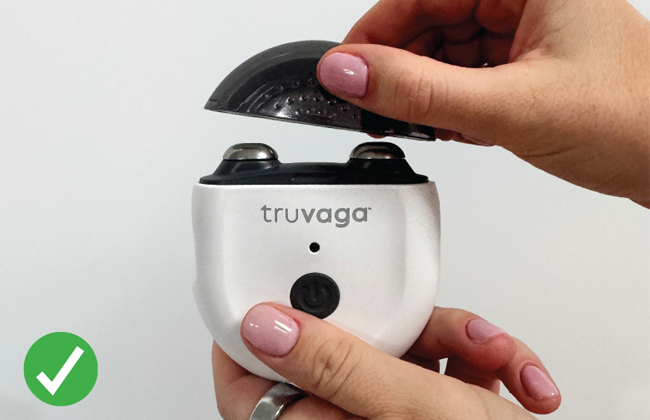
Remove Cap:
Be sure the protective cap is removed before starting your session. The electrodes must make direct contact with your skin.
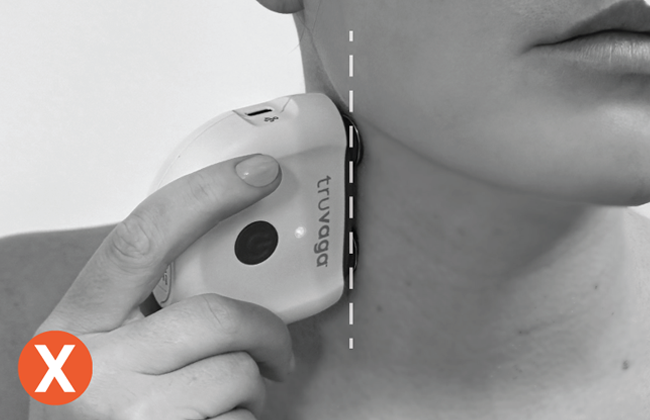
Move Device Forward:
If device is sitting under your ear or by the end of your jawbone, move it slightly forward toward the front of your neck.
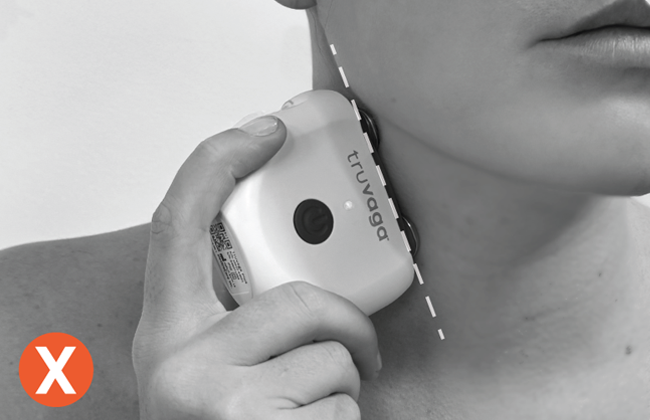
Tilt Toward Your Lip:
The device should be held vertically, with the electrodes stacked one above the other. Both electrodes should maintain continuous contact with your skin during use.
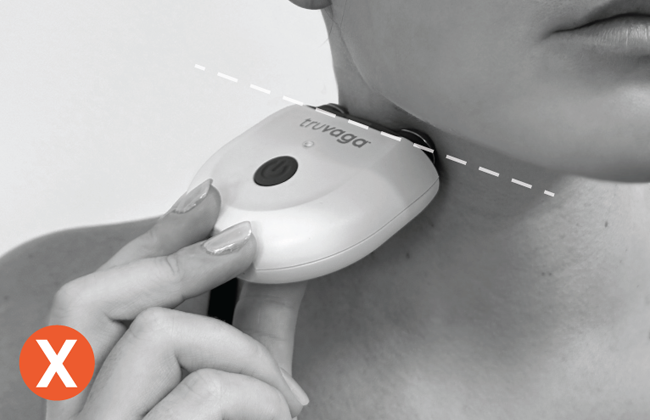
Place Vertically:
The device should be held vertically, with the electrodes stacked one above the other. Both electrodes should maintain continuous contact with your skin during use.
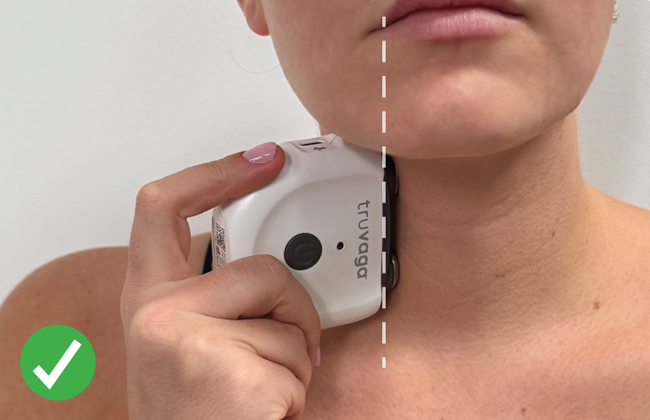
PRO TIP: Imagine drawing an invisible line from the corner of your lip straight down your neck. Placement should fall within this area.
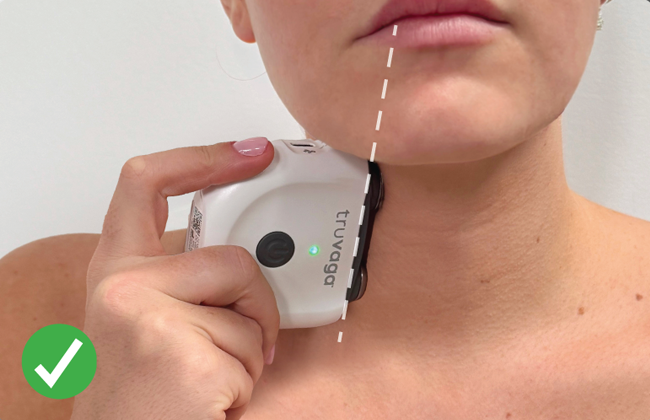
PRO TIP: A slight tilt toward your lip or windpipe is fine. If you’re not feeling anything, move farther away from the ear.
A few things that help:
- Use conductive gel or spray. Truvaga devices will not work successfully without using Signaspray or a Truvaga supplied conductive gel. This electrode solution improves the electrical connection between the device and the skin, which makes placement effective and sessions more consistent. Skipping it is one of the most common early mistakes.
- Start at a low intensity setting. Adjust the placement gradually until the characteristic lip-pull sensation appears. Once found, that spot becomes easy to return to quickly.
- Expect a short learning period. Most users find their optimal placement within the first few sessions. After that, it becomes second nature.
I also took advantage of the complimentary 1:1 training session that Truvaga offers via Zoom. It was incredibly helpful to talk to someone about my placement questions and get confirmation that I was doing it correctly.
How to Find the Right Intensity Level
I made the mistake of assuming “more = better” in my first few sessions. I turned the intensity up quickly and ended up with sessions that felt uncomfortable rather than calming. That defeated the whole purpose.
The right approach is to start at the lowest intensity setting and increase gradually from there. The goal is a noticeable sensation without any discomfort or pain. There is genuinely no benefit to pushing the intensity higher than what feels right for you. Managing the intensity level is different depending on the device you are using:
- Truvaga Plus allows intensity adjustment through a companion app, offering precise control and session tracking.
- Truvaga 350 uses a manual button, which users may prefer for its simplicity and ease of in-session adjustment.
How Long Does it Take to See Results?
After my first session, I sat quietly and noticed something that felt like a slight softening, a loosening of the tension I carry in my chest. I wasn’t sure if it was real or a placebo. Honestly, at that point it didn’t matter, because I wanted to keep going.
By the end of week two, I noticed I was waking up less wired and falling asleep more easily. By week four, the difference in how I responded to daily stressors was genuinely noticeable. The coworker comment that would have derailed my afternoon? It registered, and then it faded.
That said, results vary significantly based on your baseline stress levels and how consistently you use the device. Some users report meaningful shifts within a few days. Others may need closer to a month. The key factor isn’t any single session. It’s consistency.
Think of it like exercise: one workout doesn’t transform your fitness. But showing up day after day builds real results. I committed myself to four weeks of daily sessions before drawing any conclusions about whether it’s working, and I’d encourage you to do the same.
Realistic Benefits to Expect
Here’s what consistent daily use has looked like in practice, both for me and based on what I’ve heard from others.
A calmer response to daily stressors. Small frustrations stopped accumulating the way they used to. I became less reactive, more emotionally steady. Things still bothered me, but they stopped landing as hard.
Deeper, more restful sleep. Using Truvaga before bed became part of my wind-down routine. Falling asleep got easier. I started waking up more refreshed, even on nights where my total sleep time didn’t change dramatically.
Reduced baseline anxiousness. This one built slowly. The anxious hum that I’d accepted as background noise in my life got quieter over time. It didn’t disappear, but it became more manageable, easier to work alongside rather than fight.
Sharper mental clarity. When you’re not burning energy managing a constant stress response, there’s more left for actual thinking. I noticed this especially in the afternoon, which had historically been my foggiest window.
Truvaga Plus vs. Truvaga 350: Which one is right for you?
Feature | Truvaga Plus | Truvaga 350 |
App connectivity | Yes, Bluetooth-enabled | No |
Session customization | Adjustable via app | Manual intensity button |
Electrode solution | Signaspray included | Signagel included |
Reusability | Rechargeable, unlimited sessions | Comes with about 6 months of daily use. |
Best for | Users wanting guided, trackable sessions | Users preferring a simple, no-tech approach |
I personally use the Truvaga Plus because I liked the idea of tracking my sessions and keeping myself accountable to maintain my routine. However, if you’d prefer to keep the ritual low-tech and distraction-free the Truvaga 350 is a great option. Both use the same technology that is backed by 20+ years of science and research.
Safety, Side Effects, and Who Should Consult a Provider First
Truvaga is safe and generally well-tolerated, and based on my research most user reported side effects are minimal. If they do occur, they’re typically mild like brief tingling, temporary skin irritation at the application site, or occasional dizziness that fades quickly after a session.
That said, a few groups should consult a healthcare provider before using any nerve stimulation device:
- People with implanted medical devices — pacemakers, defibrillators, cochlear implants, and similar active implants may be affected by electrical stimulation.
- Those with cardiovascular conditions — certain heart conditions, particularly severe arrhythmias or a history of heart attack, may require medical clearance first.
- Anyone currently pregnant — vagus nerve stimulation is not recommended during pregnancy without physician approval.
Is Truvaga Worth the Cost?
I weighed this for a while before buying. When I stacked it up against what I was spending on supplements each month, or the recurring cost of therapy copayments and other stress-management tools, a one-time device purchase started looking more reasonable.
Truvaga offers a 30-day money-back guarantee, which removed a lot of my hesitation. The device is also eligible for FSA and HSA spending, which made it significantly more accessible for me.
How Truvaga Compares to Other Vagus Nerve Stimulators
When I was researching, I kept running into other devices that claimed similar benefits through different mechanisms:
- Apollo Neuro: Uses vibration rather than electrical stimulation, worn on the wrist or ankle.
- Pulsetto: A handsfree/wearable vagus nerve stimulation device.
- Sensate: A chest-based device using vibration and sound — no direct nerve stimulation.
- Neuvana: Ear-based stimulation through specialized earbuds.
What stood out most to me about Truvaga was its placement and technology. Unlike many other devices, Truvaga is used on the neck, where the vagus nerve is closest to the surface, allowing for direct electrical stimulation. I was also drawn to the depth of clinical research behind the technology. Of all the devices I reviewed, Truvaga appeared to have the most robust body of research supporting its stimulation frequency and approach.
Tips I Wish I had Before my First Session
Use enough gel or spray. Conductivity matters far more than I expected. Dry electrodes make sessions inconsistent and ineffective.
Start at a lower intensity than you think you need. You can always increase it. Starting too high made my early sessions uncomfortable and nearly derailed the habit before it started.
Attach sessions to an existing habit. I use Truvaga with my morning coffee and again during my bedtime wind-down. Pairing it with something I already do every day means I almost never skip it. It’s the same reason brushing your teeth is easy— it’s attached to an anchor.
Try slow, controlled breathing during sessions. Combining vagus nerve stimulation with deep breathing enhances the parasympathetic response. I started doing this around week two and noticed a meaningful difference in how quickly I settled into calm.
Give it four weeks before evaluating. This is the hardest one. Your nervous system didn’t develop its stress habits overnight, and it won’t retrain overnight. Four weeks of daily sessions gives you a real picture of what’s possible.
Incorporating Truvaga Into Your Overall Wellness Routine
Truvaga works well alongside other wellness practices like mindfulness, regular exercise, therapy, and good sleep hygiene. I think of it as one reliable tool in a broader toolkit, not a replacement for any of those things. On particularly stressful days, it’s the thing I reach for first.
Frequently Asked Questions About Truvaga Vagus Nerve Stimulators
Can I use Truvaga more than twice a day?
Yes, many users use it more than twice a day. . Two sessions daily is the minimum recommendation, but extra sessions on high-stress days are encouraged
Can I travel or fly with my Truvaga device?
Truvaga is portable and TSA-friendly, making it easy to maintain your routine while traveling.
Do I need to use the Truvaga Plus app for the device to work?
The Truvaga Plus must be used with the app. The app adds guided sessions, intensity control, and progress tracking that many users find valuable. If you would prefer a non-app experience, our Truvaga 350 does not require an app.
What happens if I miss a few days of Truvaga sessions?
Missing a few sessions won’t erase your progress. Simply resume your routine and stay focused on consistency going forward.
Author bio: