US
US 


Among the many influences on skin health, topical treatments, sun exposure, diet, and genetics, one of the most underappreciated may be the nervous system itself.
Ask someone living with psoriasis, eczema, rosacea, or chronic itching whether stress affects their skin, and the answer is almost uniformly the same: unequivocally, yes. A difficult week at work, a conflict at home, a stretch of poor sleep, within hours or days, their skin reliably worsens. This is not a coincidence, and it is not subjective. It reflects well-documented biology.
For most of dermatology’s history, skin health has been understood from the outside in: cleansers, moisturizers, barrier repair, laser and light therapies, pharmaceuticals. More recently, the field has broadened its view to include the gut microbiome, systemic inflammation, sleep quality, and nutrition.
But another layer of complexity has emerged from neuroscience and immunology: the autonomic nervous system, and in particular its calming branch, the vagus nerve, appears to play a meaningful role in moderating the inflammatory environment in which skin diseases thrive or resolve.
Why Does Stress Affect Your Skin? The Science Behind the Connection
The pathways connecting psychological stress to skin inflammation are no longer speculative. Research has shown that when the brain perceives stress, it triggers a cascade of hormonal and chemical signals that travel throughout the body, including to the skin, through both the bloodstream and local nerve endings.1
Several of these stress-related molecules can activate immune cells in the skin, weaken the skin’s protective barrier, and push the immune system toward a more inflammatory state. In other words, the skin is not a passive bystander during a stressful period; it is actively responding to internal signals.2
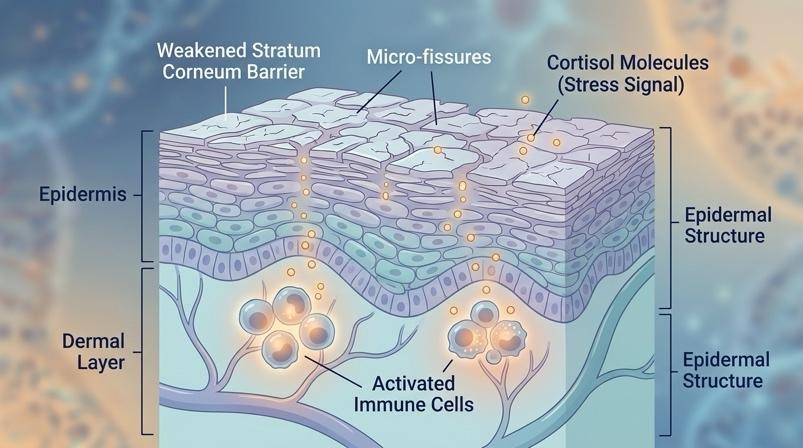
When stress becomes chronic rather than occasional, the consequences compound. The skin barrier becomes less effective, wound healing slows, and the immune system grows increasingly prone to overreaction.
The result is a skin environment that is simultaneously more inflamed, more permeable, and less resilient — which helps explain why conditions like eczema and psoriasis tend to flare during stressful periods rather than calm ones.
How Does the Vagus Nerve Regulate Inflammation and Skin Health?
The vagus nerve, named for its long, wandering course from the base of the brain through the chest and into the abdomen, is the primary cable of the parasympathetic nervous system, the part of the nervous system responsible for rest, recovery, and repair. Think of the nervous system as having two modes: an accelerator (the sympathetic system, which mobilizes the body for action) and a brake (the parasympathetic system, which helps the body recover). The vagus nerve is the main driver of that brake.
Beyond its role in recovery, the vagus nerve also appears to play a role in regulating inflammation. Research beginning in the early 2000s described what scientists call the “inflammatory reflex”: a neural circuit in which signals traveling through the vagus nerve can instruct immune cells to dial back the production of inflammatory molecules.3 Follow-up work confirmed that this pathway could reduce inflammatory responses in multiple organ systems.4
This doesn’t mean the vagus nerve simply switches inflammation off; biology is rarely that clean. Rather, it functions as part of a feedback loop that helps keep immune responses proportionate. The relevance to chronic skin disease is that in conditions like psoriasis, atopic dermatitis, and rosacea, inflammatory signaling is persistently elevated, and the mechanisms that should temper it appear less effective. Whether reduced vagal activity contributes to that imbalance is still being studied.
One way researchers estimate vagal activity is by measuring heart rate variability, the subtle beat-to-beat fluctuations in heart rhythm that reflect how actively the parasympathetic system is working. A large analysis of existing studies found that lower heart rate variability was consistently associated with higher levels of inflammatory markers in the body,5 suggesting that people with weaker vagal tone may be less equipped to keep inflammation in check.
What Is the Gut-Vagus-Skin Axis and Why Does It Matter for Your Skin?
A fuller picture of this system can no longer leave out the gut microbiome, the vast community of microorganisms living in the digestive tract. Research has established that gut microbes are in constant, bidirectional communication with the brain, and that the vagus nerve serves as one of the primary channels for that conversation.6 Microbes produce compounds that can influence immune function and inflammatory tone throughout the body, not just in the gut itself.
The skin sits at the far end of this network. Disruptions to the gut microbiome, through antibiotic use, poor diet, sleep deprivation, or sustained stress, may send ripple effects through immune and neural channels that eventually reach the skin. The specific mechanisms are still being mapped, but the broader point is becoming clearer: the health of the gut, the tone of the nervous system, and the inflammatory state of the skin are not independent of one another. They are parts of the same conversation.
How Lifestyle Habits Can Support Nervous System Balance and Healthier Skin
The encouraging news is that vagal tone is not fixed. A range of accessible, low-risk practices has been shown to shift the nervous system toward its calming, restorative mode. These include:
- Diaphragmatic breathing (particularly with a longer exhale than inhale)
- Regular aerobic exercise
- Meditation and yoga
- Adequate sleep
- Genuine social connection
- Brief cold exposure (a cold rinse at the end of a shower, for example)
- Humming and singing (the muscles involved share anatomical connections with the vagus nerve)
- Non-invasive vagus nerve stimulation
The habit elite athletes have of taking a slow, deliberate breath before a high-stakes moment is not purely ritual. It is a real physiological maneuver: a long exhale activates calming nerve signals and briefly recalibrates the nervous system. Translating that principle into everyday life, particularly for individuals whose skin tends to respond poorly to stress, seems reasonable and carries essentially no downside risk.
How Non-Invasive Vagus Nerve Stimulation Can Support Your Skin and Stress Response
Beyond lifestyle strategies, technology now offers an exciting new way to support the body’s natural resilience systems. Truvaga®, an easy-to-use, non-invasive vagus nerve stimulation device, delivers gentle electrical stimulation to vagal nerve branches accessible through the skin of the neck — helping activate one of the body’s most important pathways for relaxation, recovery, and balance, all without surgery, medications, or downtime.
What makes Truvaga particularly compelling is its simplicity and accessibility. In just a few minutes a day, users can incorporate vagus nerve stimulation into their wellness routine, helping to promote a shift away from the body’s chronic “fight-or-flight” state and toward a more restorative “rest-and-digest” mode.
Clinical interest in vagus nerve stimulation continues to grow, fueled by evidence supporting its use in conditions such as migraine and cluster headache, as well as increasing appreciation for the vagus nerve’s broad role in regulating stress, inflammation, sleep, mood, and overall physiologic balance.
While Truvaga is not a treatment or cure for psoriasis, eczema, rosacea, acne, or other skin conditions, many experts are increasingly recognizing that healthy skin is influenced by systems far beyond the skin itself. Chronic stress, poor sleep, and persistent autonomic imbalance can all contribute to a body that struggles to maintain equilibrium. Truvaga may provide a practical and empowering way to support parasympathetic activity as part of a comprehensive wellness program.
Rather than replacing foundational habits, Truvaga works alongside quality sleep, stress management, regular movement, and good nutrition to help create an internal environment that supports overall well-being. In a world where stress has become nearly unavoidable, Truvaga offers a science-backed, convenient way to intentionally activate the body’s built-in reset button.
Why a Whole-Body Approach Is the Future of Skin Health
The traditional question in skin care: “What should I put on my skin?” is not wrong, but it is increasingly incomplete as a full picture. Skin health is shaped substantially by what is happening internally: how well we sleep, how the immune system is calibrated, how much chronic stress we carry, and how the nervous system responds to all of the above. The vagus nerve, as a central node connecting the brain, gut, immune system, and peripheral tissues, is a reasonable focus for anyone interested in addressing skin health from the inside out.
Although the science here is still developing, clinical evidence directly linking vagal interventions to improved skin outcomes remains limited, and strong claims in either direction would be premature. However, the broader shift toward understanding skin as an organ embedded in whole-body physiology, rather than one that can be treated in isolation, is almost certainly the right direction.
Sometimes the most important thing happening to your skin cannot be seen from the outside at all.
Frequently Asked Questions About Skin Health and the Vagus Nerve
How does stress affect skin conditions like eczema and psoriasis?
When the brain perceives stress, it triggers a cascade of hormonal and chemical signals that travel to the skin through the bloodstream and local nerve endings. These signals can activate immune cells, weaken the skin’s protective barrier, and push the immune system toward a more inflammatory state. Over time, chronic stress compounds these effects, slowing wound healing, increasing permeability, and reducing skin resilience, which is why conditions like eczema and psoriasis tend to flare during stressful periods.
What is the vagus nerve’s role in skin inflammation?
The vagus nerve is the primary driver of the parasympathetic nervous system, the body’s rest, recovery, and repair mode. Research has identified what scientists call the “inflammatory reflex,” a neural circuit in which vagus nerve signals can instruct immune cells to reduce the production of inflammatory molecules. In chronic skin conditions where inflammatory signaling is persistently elevated, supporting vagal tone may help the body better regulate its immune response.
What is the gut-vagus-skin axis?
The gut-vagus-skin axis describes the bidirectional communication network connecting the gut microbiome, the vagus nerve, and the skin’s inflammatory environment. Gut microbes produce compounds that influence immune function throughout the body, and the vagus nerve serves as a primary channel for that communication. Disruptions to the gut, through stress, poor diet, or sleep deprivation, can send ripple effects through this network that ultimately show up in the skin.
Can vagus nerve stimulation support skin health?
Yes, while vagus nerve stimulation is not a treatment for skin conditions, supporting parasympathetic activity can help create an internal environment less prone to chronic inflammation. Non-invasive devices like Truvaga offer a practical, accessible way to activate the vagus nerve daily, complementing foundational habits like quality sleep, stress management, and good nutrition as part of a whole-body approach to skin wellness.
References:
- Arck PC, Slominski A, Theoharides TC, Peters EM, Paus R. Neuroimmunology of stress: skin takes center stage. Journal of Investigative Dermatology. 2006;126(8):1697–1704. https://pubmed.ncbi.nlm.nih.gov/16845409/.
- Roosterman D, Goerge T, Schneider SW, Bunnett NW, Steinhoff M. Neuronal control of skin function: the skin as a neuroimmunoendocrine organ. Physiological Reviews. 2006;86(4):1309–1379. https://pubmed.ncbi.nlm.nih.gov/17015491/.
- Tracey, K. The inflammatory reflex. Nature 420, 853–859 (2002). https://doi.org/10.1038/nature01321
- Tornero C, Pastor E, Garzando MDM, Orduña J, Forner MJ, Bocigas I, Cedeño DL, Vallejo R, McClure CK, Czura CJ, Liebler EJ, Staats P. Non-invasive Vagus Nerve Stimulation for COVID-19: Results From a Randomized Controlled Trial (SAVIOR I). Front Neurol. 2022 Apr 8;13:820864. doi: 10.3389/fneur.2022.820864. PMID: 35463130; PMCID: PMC9028764.https://pubmed.ncbi.nlm.nih.gov/35463130/
- Thayer JF, Åhs F, Fredrikson M, Sollers JJ, Wager TD. A meta-analysis of heart rate variability and neuroimaging studies: implications for heart rate variability as a marker of stress and health. Neuroscience & Biobehavioral Reviews. 2012;36(2):747–756. https://pubmed.ncbi.nlm.nih.gov/22178086/
- Cryan JF, O’Riordan KJ, Cowan CSM, et al. The microbiota-gut-brain axis. Physiological Reviews. 2019;99(4):1877–2013.https://pubmed.ncbi.nlm.nih.gov/31460832/
Author bio: