US
US 


Watch almost any elite performer before a defining moment, and something becomes visible.
The basketball player steps to the free-throw line and pauses. The golfer stands motionless over the putt and exhales. The sprinter settles into the blocks and draws one final, deliberate breath. The speaker waits in the wings, eyes closed, before walking into the light.
In those few seconds, something physiologically profound is occurring. These performers are calming their nervous system, centering attention, and harnessing their energy rather than being consumed by it. They are stimulating the vagus nerve — perhaps the most underappreciated performance tool available to any of us.
Regenerative Braking and the Body: How Your Nervous System Recovers Energy
In 1880, an engineer named Frank Sprague introduced a principle that would quietly revolutionize how we understand energy, motion, and recovery.
When a vehicle brakes, the energy produced is typically lost as heat — dissipated, wasted, gone. Sprague’s insight was that this energy need not be wasted at all. It could be captured, stored, and redirected forward to propel the vehicle again. This is regenerative braking. If you drive an electric vehicle, you experience it every time you lift your foot from the accelerator. The car does not simply coast. It recovers.
The human body operates on a remarkably similar principle.
The Sympathetic vs. Parasympathetic System: Your Body's Accelerator and Brake
Across every major physiological system, the body maintains a paired architecture: one mechanism that drives activation, one that governs recovery. Health is a dynamic balance between these opposing forces.
Accelerator | Brake |
Sympathetic nervous system | Parasympathetic nervous system |
Excitation | Inhibition |
Inflammation | Resolution |
Growth | Repair |
Action | Recovery |
Energy expenditure | Energy conservation |
The problem is not the accelerator. The problem is becoming chronically unable to release it.
Modern life applies near-constant pressure to the gas pedal. Deadlines, notifications, competing demands, performance expectations- these all register as a signal to activate. Without an equally practiced ability to shift into recovery, the system accumulates a kind of physiological debt.
The result is familiar: reactive rather than responsive, scattered rather than focused, depleted rather than energized. The body’s regenerative braking stops working. Energy that could be recovered is lost as anxiousness or ineffective actions.
The Vagus Nerve: Your Body’s Reset Mechanism
The vagus nerve is the longest cranial nerve in the body. Its name derives from the Latin vagus, meaning “wandering”, apt for a nerve that travels from the brainstem through the heart, lungs, and digestive tract. This nerve communicates with virtually every major organ system. It is also the primary anatomical pathway of the body’s brake.
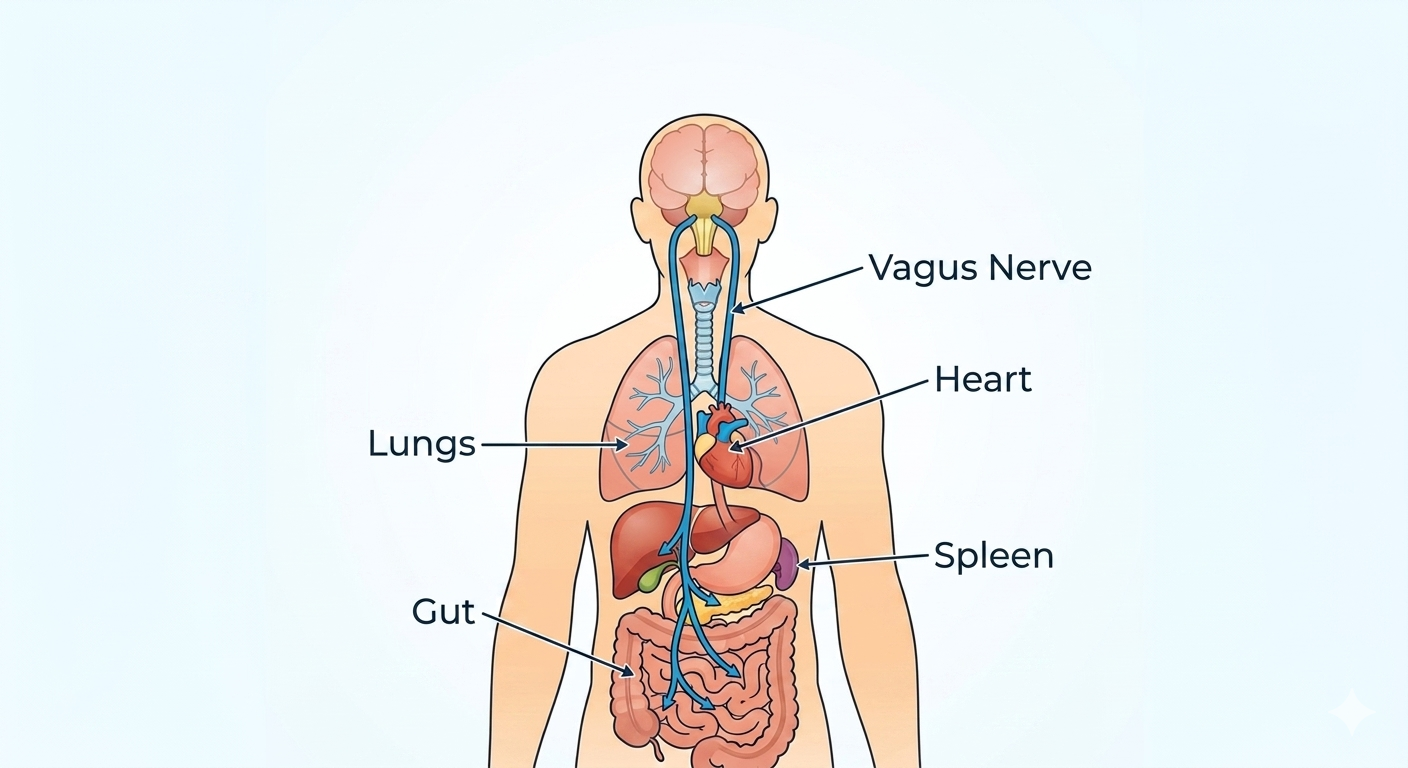
When the vagus nerve is stimulated, heart rate decelerates, stress hormones fall, emotional reactivity diminishes, focus sharpens, and the body shifts toward restoration and repair. In physiological terms, it sends a signal the nervous system recognizes as safety: perform from composure, not chaos.
Breathwork and the Vagus Nerve: The Fastest Free Reset for Performance
There’s a reason why deep breathing, box breathing or other breathing techniques are highly favored in stressful scenarios to calm ourselves down. The most readily accessible tool is to inhale slowly through the nose for four seconds; exhale gently for six to eight. That single breath cycle, repeated three to five times, can meaningfully shift physiological state in under sixty seconds.
The best performers do not eliminate pre-performance nervousness, they regulate it. Confidence is frequently the byproduct of a regulated nervous system, not the absence of activation.
Where the Reset Belongs
- Before a high-stakes moment. A presentation, a client meeting, a critical negotiation or any situation requiring composure and authority. A minute of deliberate breathing before entering that room changes the conditions under which performance occurs. The nervous system arrives calibrated rather than reactive.
- During a frantic day. Most people move from task to task without transition, the nervous system never catching up. Accumulated arousal compounds, and the reactive state appropriate for one context contaminates all the others. A brief reset interrupts that cycle. It is not a luxury. It is maintenance.
- When shifting the type of focus required. This is where the reset becomes most strategically valuable, and where a precise understanding of attention matters most.
For people looking to make this reset more consistent, tools like Truvaga, a handheld vagus nerve stimulation device, can complement practices like breathwork as part of a daily performance and recovery routine. It builds on the same idea as breathwork: helping the nervous system shift from stress and overactivation into a calmer, more focused state.
Vagus Nerve Stimulation Devices: How Science Is Expanding the Performance Toolkit
Breathing remains the foundational technology free, portable, and always available option. Though easily accessible, breathwork may not always directly stimulate the vagus nerve. Scientific understanding of the vagus nerve has advanced considerably, and with it, new options have emerged.
Non-invasive vagus nerve stimulation (nVNS) devices now allow external stimulation of vagal branches without surgical implantation. These technologies are being explored for stress management, cognitive resilience, recovery, sleep quality, and overall nervous system regulation.
One such device is Truvaga, a handheld wellness tool that delivers non-invasive vagus nerve stimulation through gentle external pulses. Many users incorporate it into daily rituals: before presentations, during high-demand periods, or as part of a structured recovery practice.
The goal is not sedation. It is optimization: deliberately shifting the nervous system from survival activation into calibrated, focused performance. Think of it not as a replacement for the breath, but as a more precise application of the same underlying principle.
Why Recovery Is the Real Competitive Advantage
The dominant cultural narrative around peak performance equates excellence with relentless intensity. It is a compelling story. It is also incomplete.
The defining characteristic of elite performers across sport, business, healthcare, and every other domain is not how hard they can push. It is how effectively they recover and how deliberately they can regulate the state from which they perform.
The brake is not the opposite of performance. The brake is what makes sustainable performance possible.
“The fastest path to peak performance sometimes begins with slowing down.”
Frequently Asked Questions about Performance and the Vagus Nerve
Why do elite athletes pause or take a breath before a big moment?
That brief pause is more than a ritual; it’s a physiological reset. Deliberate, controlled breathing can stimulate the vagus nerve, which activates the parasympathetic nervous system. This slows the heart rate, reduces stress hormone levels, and shifts the brain from reactive mode into focused, composed readiness. In just a few seconds, top performers are recalibrating their nervous system to perform from a place of control rather than anxiety.
What is the vagus nerve and why does it matter for performance?
The vagus nerve is the longest cranial nerve in the body, running from the brainstem through the heart, lungs, and digestive tract. It serves as the primary pathway for the body’s recovery (“brake”) system. When activated, it reduces emotional reactivity, sharpens focus, and signals physiological safety to the brain. Researchers increasingly view healthy vagal tone as a key component of resilience, cognitive performance, and the ability to recover quickly under pressure.
What is the best breathing technique to calm nerves before a high-stakes moment?
A simple, research-backed technique: inhale slowly through the nose for four seconds, then exhale gently for six to eight seconds. Repeating this three to five times activates the vagus nerve and can meaningfully shift your physiological state in under sixty seconds. The extended exhale is key; it’s what can trigger the parasympathetic response and signal to the nervous system that the threat has passed.
What is non-invasive vagus nerve stimulation (nVNS), and how is it used for performance?
Non-invasive vagus nerve stimulation (nVNS) uses a handheld device to deliver gentle external pulses that stimulate vagal nerve branches — no surgery or prescription required. Devices like Truvaga are used by individuals looking to support stress management, mental clarity, recovery, and sleep quality as part of a daily wellness routine. Rather than replacing breathwork, nVNS offers a complementary, more targeted application of the same underlying principle: deliberately shifting the nervous system from activation into calibrated, focused performance.
Author bio: